by Zach Smith | Feb 29, 2020 | Care, Elms, Potting, Styling, Water Elm, Wiring
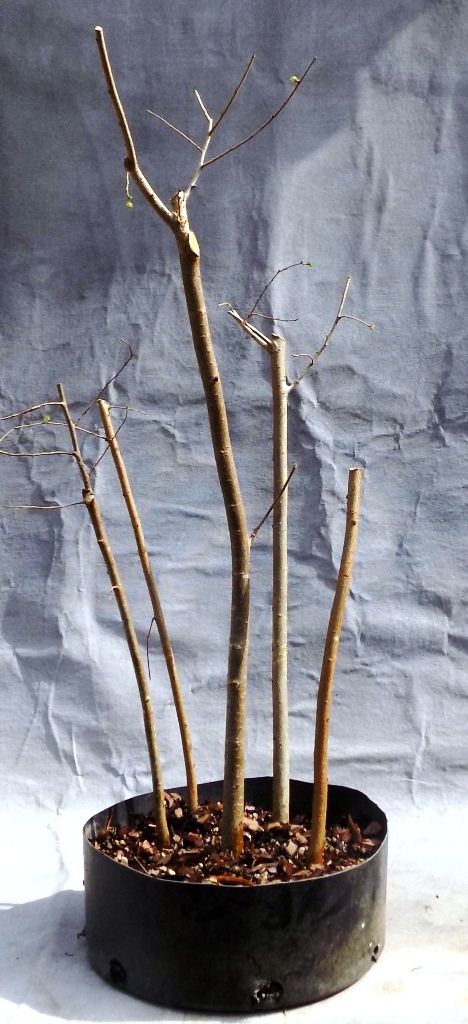
I’ve had the bonsai forest bug for a while now. I’ve always loved good forests, but only made a limited number. In the past year, I’ve really ramped up the assembly line. During this past summer’s Water-elm collecting season I intentionally set about to harvest some smaller trees with great character, so I could make a few unique forest bonsai from them. This trio was among them. Previously I wired and shaped the individual trees, and now that they’re starting to come out it’s the perfect time to bring them together. In any forest planting, the whole needs to exceed the sum of the parts. Let’s see if I can make this happen.
Because I had potted the two larger trees together with the intention of their roots growing together (that’s what you want in a forest), they were placed in this fine Byron Myrick tray in more or less the same position they started out. I think this is going to work well.
Though it’s sometimes hard to look beyond the focal tree or trees, at the end of every forest plan it’s the smallest tree(s) that makes the composition work. Why? Because part of the illusion of bonsai is a sense of depth in the planting. With individual trees, this is achieved by making sure there are open spaces in the tree’s structure that allow you to see from front to back. With group plantings, small trees placed toward the rear create this illusion due to the forced perspective it accomplishes. Now, with that said you have to ask yourself this question about this specific placement of the smallest tree – does it work, and is it harmonious? The answer is a very obvious no. Why is that? The two focal trees are growing in a pattern that suggests what you’d see in nature – that is, they have grown somewhat apart from one another to ensure they get the sunshine they need. That makes sense, and with the two focal trees there’s balance and harmony in their trunk lines taken together visually. But that small tree in the back? It’s growing right toward the middle tree, and that’s a disruption of the harmony achieved with the main trees.
Doesn’t this make all the difference in the world! All I had to do was turn the smallest tree so its trunk movement became harmonious with that of the two larger trees. So simple; so game-changing.
Here’s the forest after securing everything and filling the tray with soil.
Fed, mossed, watered. This is exactly what I was thinking last summer when we were searching for smaller Water-elms. I hope you like this forest as much as I do. The trees should continue to push new growth, and by the time another 4-6 weeks pass I should be doing the first trim on it. Just to give you an idea of size, the larger trees have trunks about 1″ thick; the overall height of the finished forest will be about 12″. I plan on posting this forest for sale in about a month, so stay tuned if you’re interested.
by Zach Smith | Feb 23, 2020 | Care, Elms, Flowering, Maples, Potting, Water Elm
I potted up this Water-elm last year. It’s a specimen from the 2018 collecting season, and since Water-elms develop so quickly I was able to move it along less than a year after it was first lifted. It’s a nice composition, but there’s one problem with it – the pot is just a bit too small. It’s starting to come into leaf, so today was the perfect time to repot into a more suitable container.
This was a pretty quick operation. The original pot and this one are both by Lary Howard; each is unique, but this one suits the tree better. I did have to do some light root-pruning to ensure the perfect fit, but the tree won’t care.
I was also able to lift the tree slightly in the pot, which shows the surface rootage better. Ramification is going to be the first order of business during this growing season. With Water-elms, I’ve found that grow and clip is the technique of choice once the original design is made by means of wiring and shaping. Occasionally you’ll need to do some wiring on a mature specimen, but it’s generally minimal.
This tree is available at our Water-Elm Bonsai page, if you’d like to take over the refinement work.
Sometime there’s more to the story. I started playing around with this Boxelder last year. I got a nice branch set in place, and carved down the trunk chop, and the tree went into dormancy like clockwork. Now the first signs of growth are on it, and since I really like the way it’s shaping up and since my expectations for it are firmly in check (it being a Boxelder and all), I thought I’d like to pot it up. Why not? The only problem was, I didn’t have a pot suited to it. Except … that pot the Water-elm was in looked like fitting this tree pretty well.
The tree had plenty of roots when I lifted it, so I’m confident it’s going to continue leafing out and not look back. I think the pot works very well with it. So I’ll give the tree some food and ignore it for awhile. Stay tuned for an update later in spring (assuming all goes well).
I got this Lantana from another collector last fall. It’s been in this homemade concrete training pot since I got it, but now it’s pushing new growth and today was the day it needed to go into a nice bonsai pot.
I think this Chuck Iker round just makes the tree. What do you think?
by Zach Smith | Feb 19, 2020 | Care, Chinese Elm, Elms, Potting, Styling
If I had to select only one species to grow as bonsai, it would be Chinese elm (Ulmus parvifolia). If I had to select the one species grown for bonsai that has been most abused by the commercial bonsai industry, it would be Chinese elm. Be that as it may, I always recommend the species to beginners and veterans alike. And last year I stocked in 300 liners, so I can strike a blow for better Chinese elm bonsai in the coming years. It won’t make a dent in anything, but at least there will be some decent specimens on the market.
Here’s a three-tree planting I did back in 2015. It only took a year from sticks in pots to get to this point (before the composition went to a client). That’s one of the great features of Chinese elm. It takes relatively little time to make them look like real trees.
You may remember this forest from last year. It had grown by itself as root “cuttings” from a spot where I’d previously lifted a single-trunk specimen. I hadn’t expected that sort of thing, so, happy accident as they say. My expectations for this specimen in 2020 are very high – so much so that I predict my forest will look very forest-like by the end of the season. Again, that’s a feature of the species more so than what skill I may bring to the table. With rapid growth, naturally small leaves that get smaller readily and a tendency to looked “aged” while still young (the bark will turn gray by year two or three in a pot at the latest), I’ll have something very quickly.
Here’s another of those happy accident root-zone forests. I lifted the individual trees the other day, and took the chance of direct-potting into this lovely Byron Myrick tray. One reason I felt I could take that chance was the fact that all of the trees were coming into leaf or pushing buds. I’ve had less than stellar results lifting Chinese elms in the dead of winter. They’re easy to harvest in summer, when in full leaf. I’m confident that at the start of active growth, while temps are still mild, I don’t have any need to worry about their making it.
Here are the five trees that I didn’t use for the forest shown above. I’ll be able to slip-pot this group around May or so.
I love “tall tree” forests, as you can probably tell from the photos posted above as well as this one. This is a 2014-vintage shot of a seven-tree group, before it went to a client. It took only two years to bring it to this point. I can spend hours enjoying bonsai like this one. If you don’t have one, get yourself a Chinese elm bonsai. I don’t recommend the awful “S” curve specimens, but these can often be regrown into something worthwhile. You can also stay tuned for examples from us. I have over 60 of my 300 in the ground right now, so they’ll start hitting the site before you know it.
by Zach Smith | Feb 15, 2020 | Care, Elms, Potting, Pruning, Styling, Water Elm
I love raft-style bonsai. We often find Water-elms (Planera aquatica) growing naturally in this style, as their tendency is to grow naturally in a shrub-like form. We brought this one home last summer, and it recovered very nicely. I’ve been itching to work on it, and with buds starting to swell this is an ideal time.
As with any raw material you choose to work on, you’ll have to figure out what your optimal design is and how to achieve it. In total there are nine trunks possible with this specimen; however, both aesthetically and horticulturally, those two inner trunks just can’t stay. Why? For one, they are short trunks surrounded by tall trunks. Do trees grow naturally this way? No, the shorter inner ones get shaded out and die. So that’s an obvious reason to remove these two. Also, in a forest planting you can’t see shorter specimens in the interior even if they could be maintained. So there’s another reason to remove the two inner ones we have here.
That opens things up quite a bit, and really improves the appearance of the whole group. Amazing what simplifying your design can do.
I was left with two very small trunks in the group, and frankly they didn’t add anything to the composition. With them gone, I’m left with all I really need to make this raft-style bonsai to be an outstanding specimen.
In the prior photo you probably noticed the crossing trunks. One good piece of wire later, and that problem is solved.
I had this wonderful Lary Howard pot available, and for me this just makes the composition complete.
Watered, fed and mossed. I just love it when a bonsai design concept works out. Let me know what you think of this one. Do you love raft-style bonsai as much as I do?
by Zach Smith | Feb 9, 2020 | Care, Elms, Potting
Here’s a Cedar elm that needs repotting. It was collected two years ago, and has filled out wonderfully well. This growing season should see a finished bonsai of this specimen.
Repotting time is always the time to make corrections to the rootage of your bonsai. In the case of this tree, I have a large and ugly root on one side. Once I dig into the root mass, I’ll have an idea of how to make it better.
The other side of the root mass. There are a couple of roots that need to be taken off altogether.
A closer look at the ugly root I need to work on.
Starting the process of making this root better. If you don’t have a root splitter (a big and awesome tool, it makes short work of both roots and large branches), get yourself one. It’ll pay off sooner than you think.
With more work on this root, using a knob cutter relegated to below-ground carving, I’ve taken a lot of the “weight” off and this will make the root a lot less obtrusive.
You may be asking, Will this harm or kill the root? No, the root will not only continue to do its thing, it’ll heal over vigorously as this is a characteristic of Cedar elms.
Finally, the tree is back in its pot and ready for the 2020 season. Barring unforeseens, this tree will start leafing out within a week or so, stimulated by the root work.
I really like this elm bonsai. The design is unusual (something the tree did more or less on its own when it was rebudding), and elegant. The twigging will increase this year, and leaf size will reduce nicely.
I’d love to hear what you think of today’s work.
by Zach Smith | Feb 3, 2020 | Care, Chinese Elm, Elms, Potting, Pruning, Soil, Watering
Repotting our trees is a key bonsai practice, and one that you must gain mastery of. Here is a summary of basic steps you’ll take each time you repot your trees:
- Make sure you have all necessary tools and supplies, including prepared soil, before you start
- Have a suitable space to work in – outdoors a bench is ideal, indoors a small bench or table and a large tub to work in will help keep the mess contained
- Prepare the new pot if you’re changing pots; if not, you’ll need to thoroughly clean the existing pot, replace drainage screen and the tiedown(s)
- Unpot the tree and inspect the root mass
- Comb out the roots which will have coiled their way around the outer edges of the mass
- Trim away the overlong roots and enough of the root mass to give room for fresh roots to grow
- Make needed corrections to the roots, namely the exposed nebari roots that are part of your design
- Add fresh soil to the pot to provide a thin bottom layer – slightly heaped in the middle
- Place the tree in the pot
- Tie the tree down once you’re satisfied with the placement
- Fill in all around the tree and any spaces in the root mass; use a chopstick or other tool to work the soil in
- Water thoroughly; allow to drain; water thoroughly a second time; newly potted or repotted trees with fresh soil will need to be watered more frequently than others, as it take a while for the fresh soil to become properly wetted
- Fertilize (this is optional at this time, but I tend to forget as I move on to other trees, so I go ahead and do it at the time of repotting)
- Place moss on the surface if so desired.
This is today’s subject, the Chinese elm that has its own Progression page.
It was last repotted in 2018, and though it could probably go another year without it, there are a couple of issues with the nebari that I want to correct before they get out of hand.
This is one of the roots that I’m unhappy with. Though it’s grown well and is about healed from the previous pruning I did, it’s just too straight and untapering a surface root to remain. I can solve this problem as part of the repotting process.
This one’s a little harder to see, but the surface root at the left has a smaller root coming off it that runs at an angle back toward the base of the tree. It’s also too long without taper and needs pruning back.
Step number one, the tree is pulled from the pot. It’s at this point that you do the assessment of the root mass. Look for any root rot caused by poorly draining soil. Always cut away any dead roots – you can’t eliminate all the fungal pathogens by doing this, but removing the dead roots and using free-draining soil when you repot will allow the tree to recover on its own (which it should do). Expect to see fresh white feeder roots when you inspect the root mass. This is a good sign, of course. Don’t worry about trimming these off as a necessary part of pruning the roots to make the mass more compact; the tree will happily grow new ones.
I combed out the root mass, trimmed away some of the excess roots, and washed off the excess soil that I’ll be replacing. It’s easier to see root problems once you get to this stage. In this case, it’s a root that’s coiling back toward the trunk base. These should either be removed entirely, or if you need a root that’s grown this way then gently uncoil and trim it so it grows in the desired direction.
Here I’ve pruned that first of my large offending surface roots. I’ve also removed the coiling root that I don’t need since I have a good mass of roots to support the tree.
In this photo you can see that I’ve pruned back the large root even more. My goal is to build the taper of this surface root. By pruning it back, I can expect the roots already branching off this one to continue to thicken over time. That should produce the effect I want.
Here’s the view from the other spot where I have that odd root moving back toward the trunk. There’s obviously work that needs doing.
The offending root is gone, and I’ve pruned back the too-straight surface root as I did the other one. I’ll be able to build taper with this one as well.
Here’s the tree after the final root trim. I’ve removed about a third of the total root mass, which is the right amount for this repotting. The amount of root mass you remove will vary based on how long it’s been since the last repotting, and how much root the tree has grown in the interim. With experience you’ll be able to immediately gauge this as soon as you pull the tree from the pot.
Here I’ve placed the tree back in its pot. I previously washed the pot thoroughly, made sure the drain screens were in good shape, and replaced the tiedown wire.
Placing your tree in its bonsai pot requires you to consider several parameters to ensure the composition is its best. They are (in no particular order):
- Determine the correct placement of the trunk base – in this case, since my tree emerges straight from the soil and terminates left of center at the apex, the base needs to sit slightly toward the right side of the (oval) pot
- The tree also needs to sit slightly to the rear of the pot
- The tree sits on a slightly heaped mound of soil, which brings the base just above the rim of the pot
- I had previously selected this pot because it is, in profile, roughly as deep as the trunk base is wide
- The pot measures about one-half the height of the tree in length, making for a good proportion
- The initial portion of the trunk emerges straight from the soil; the planting angle needs to be such that the initial portion of the trunk is perpendicular to the pot rim.
The tree has been tied down (I use a single tiedown for most of my bonsai; use however many work best for you), and the pot filled with soil. This step requires a lot of care. You can’t leave any gaps beneath the surface of the soil, because that spot will dry out and any roots there will die. Most everyone uses a chopstick to work the soil into and around the root mass. Some will say never to jab the chopstick into the root zone when you do this; I’ve never found this to cause a problem, since there really aren’t that many tender roots present at this stage of the process. If you’re concerned, then you can carefully insert your chopstick and wiggle it back and forth to work the soil in.
Here’s a closer look at the nebari. I’ve improved the surface rootage quite a bit, and this should result in a much better bonsai in a fairly short time. This tree has been in training since 2014, so the next few years should complete the making of this Chinese elm bonsai.
The final presentation for today. I did a little trimming of the branches (there’s probably a little more to be done), then watered and placed some moss on the surface. I also added some time-release fertilizer so I don’t get busy with other trees and forget. Because I’ve done root work on this tree today, it’s probably going to start opening buds within the next week. I have a lot of small Chinese elms in gallon pots, and most of them area already leafing out. Spring is getting closer by the day!
Let me know what you think of this repotting job.