by Zach Smith | Oct 31, 2017 | Care, Elms, Pruning, Water Elm
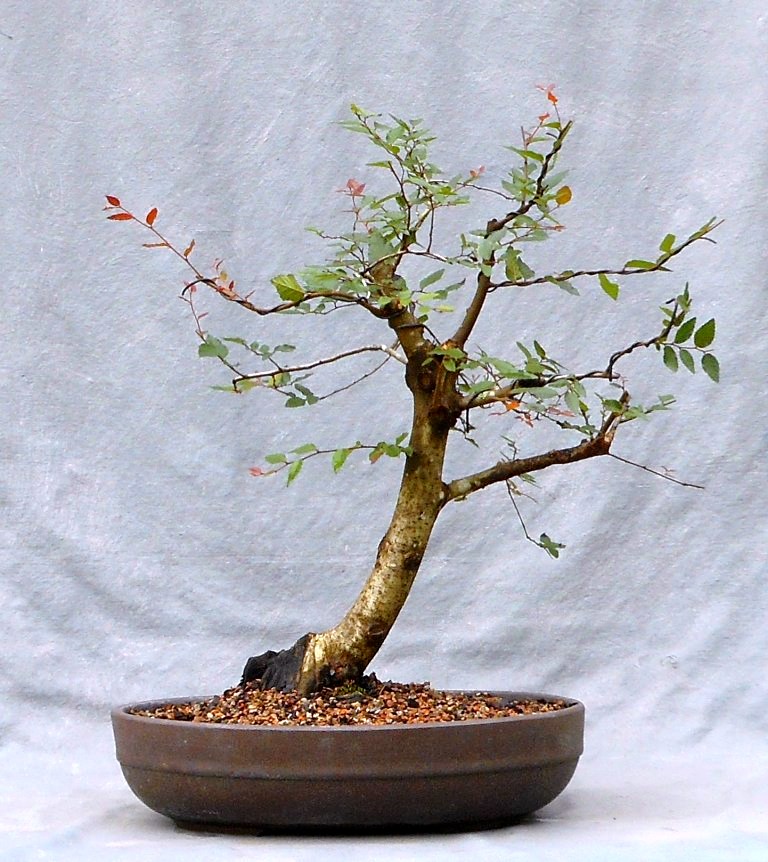
Today’s Halloween, and Halloween is my birthday, so I took the day off and it turned out to be a perfect day to do some work on the Dragon, my super-duper Water-elm (Planera aquatica). For those of you unfamiliar with this tree, here it is in “stick” form back in Summer 2015. A not-so-humble beginning – trunk base 5.5″ across, 42″ in length, nice “dragony” trunk.
Here it is back in July, after getting wired and growing and getting unwired and trimmed.
Here’s the first shot from this morning. The tree is developing right on schedule. But it does need to have the dead wood treated with lime sulfur. It’s mostly very durable, but I don’t want to see any insect damage.
After the trim and treatment. I’ll pot up this tree in the spring, once I have the custom pot in hand that I’ll be ordering soon. I also need to carve out the shari into the new apex. Easy stuff.
I caught a glimpse of this tree from another angle, and wondered if I had the front right.
I think there are definitely two options. This one seems a good bit more dramatic.
What do you think? Speak before it gets potted in spring!
by Zach Smith | Aug 13, 2017 | Care, Elms, Potting, Styling, Water Elm, Wiring
Once you’ve done bonsai long enough you will have killed your share of trees. We won’t go into all the causes, but it’s pretty much a given that sooner or later you’ll lose trees to weather or climate: weather from too much heat and not enough water or from freezing; climate when you try to grow a Japanese white pine in the Deep South (I gave that as an example because I did it early in my bonsai career); fill in the blank here ______ with your own tragedy.
This Water-elm, Planera aquatica, was off to a good start as a triple-trunk specimen back in 2013.
Then came the winter of 2014 and that icy snowy freezing event I’ve written about before. Most of my Water-elms were killed dead as a doornail. A couple came through fine (one on the ground, the other in an oversized tub); a couple sprouted from the root base. This was one of the latter – a “Lazarus” tree, as it were.
There really wasn’t much left of it, but it went to all that trouble to stay alive so I decided to put it in the ground and see if I could grow it back out into something. That happened in 2014. True to its determination to stay alive, it continued its regrowth in the ground and I more or less ignored it while it did so.
This year I decided to lift the tree in order to see if I had anything worth working on. Here’s my initial effort.
As you can see, the tree has a nice broom-form structure that happened without any intervention on my part. That’s just the way it grew.
If you look more closely at the base, you can see that the regrowth occurred over/around deadwood that actually existed (at least partially) when I first collected the tree. This photo shows the shari at the base of the tree, which was a really neat feature. This wood is pretty solid, considering that it’s been in contact with the soil for many years.
Today I decided it was time to work on this specimen. I also needed to move it to a different pot, because the one I started it off in was too large and (to be honest) too expensive.
I did a lot of “editing” of the branch structure, removing superfluous branches that didn’t add anything to the design. I also did a little wiring and positioning of branches to fill out the tree. Once it gets some ramification going, I think it’ll be a pretty decent specimen, especially for a tree that nearly died.
The training pot it’s in now is in better scale with the tree. It may ultimately find its way into a handmade pot; time will tell.
For purposes of scale, the root base is 2.5″ across (including the dead wood), and the tree is 17″ tall.
Let me know what you think of this tree. It’s had quite a history in just a few short years.
by Zach Smith | Aug 6, 2017 | Care, Elms, Potting, Styling, Water Elm, Wiring
A bonsai is a tree, shrub or woody vine potted in a shallow container and trained so that it looks like a mature tree in nature. Getting from tree, shrub or woody vine to that ideal composition, however, requires a significant array of decisions and manipulations. We start with the plant specimen. We envision a design by considering trunk, branches and root base. We trim, wire and position trunk and branches so that our design takes shape. And finally we select a proper container for the bonsai-to-be and complete our composition by placing the tree in the container.
This is a gross over-simplification, of course. But I hope in this post to give you some guidance that will make this whole mysterious process a little easier.
Let’s start with our Cedar elm friend from the other day.
When I decided to do the initial styling of this tree, I had to make some decisions that would ultimately produce the best outcome for it. In doing so, my first order of business was to figure out what I had and the different options available.
I can tell you that every piece of material you work on is going to present you with multiple options – even if some of those options are downright terrible.
Let me give you an example with this specimen.
On first glance you can’t help but see a normal upright tree form. This is what you’re supposed to see, by the way, because that’s pretty much what this tree is. Nothing especially fancy about it. But someone might suggest to you that the tree needed to be chopped to the lowest shoot and regrown over time. This is actually something that could be done.
But frankly I’m unconvinced that this will be a better bonsai in five or six years, when a new trunk has been regrown and perhaps a branch set is in place.
Sometimes the simple answer is the answer.
When I look at a tree like this, it just says upright bonsai and it’s got nice bark and taper and some branches I can work with.
At the end of the opening act for this bonsai-to-be, I had a workable set of branches, a front, and a planting angle. That’s what I “heard,” so that’s what I did.
Fast-forward two weeks.
I just got in some rectangular pots I special-ordered from Byron Myrick. This tree is best-suited to a rectangle; it has a masculine appearance, and a rectangle would enhance that appearance. So it was time to push the envelope again.
The tree had produced a lot of roots, so I slip-potted it with minimal disturbance to the roots.
Now, when I pulled the tree from the pot, I discovered a nice flaring root on one side. In order to take advantage of it, I potted the tree at an angle.
‘Cause the tree said so.
I think the composition is a good one. The rectangle suits the tree well, and its color should complement the Cedar elm fall colors (yellows and bronze-yellows) very nicely.
Here’s another example of listening to your tree, a Water-elm I lifted from my growing bed today. It has a nice, slender trunk with subtle movement. It’s a feminine specimen, no doubt about it. There’s one low branch, and I chopped off the trunk that extended a few feet above what you see now as the apex. It’s a tall tree, about 20″, with a trunk base of 1.25″. These are not your normal bonsai proportions, of course, but as I studied this tree I just couldn’t bring myself to chop the trunk down where that low branch is. That’s the standard way to approach trees like this one.
It’s been done millions of times. So why should I do that yet again?
This tree seemed to want to be different, and it just so happened that I had a really different pot for it. Chuck Iker made it, and it’s been sitting on my shelf for some time now, waiting for the right tree. Well, today the match happened. The low profile of the pot is just what this tree needs. The tree is feminine, so the round pot complements it perfectly. The pot actually looks like it’s relaxed, doesn’t it?
The tree should push new buds in two weeks, assuming all goes well. I don’t plan to create a full foliage mass. I think this one should be airy and light, and unless it says something else along the way that’s what I plan to do.
So what’s the message here? Well, most of the time when you choose a tree to work on you’ll get an impression of what the tree wants to be, just from the way it’s chosen to grow. Or, as in the case of the Water-elm above, you’ll see a trunk line that looks right even though it may not fit the “normal” design ideas we usually gravitate toward. Try going with what the tree is telling you. It may take some practice, but I think you’ll find some really cool designs for your bonsai that way.
by Zach Smith | May 14, 2017 | Care, Collecting, Elms, Styling, Vines, Water Elm, Wiring
“Dragon” the Water-elm put on a lot of growth last year, as you can see in this photo where I can’t get it all in the frame. I left it to grow without any restraint last year because the branches need to gain heft. But there does come a point where you have to prune to encourage more growth – plus you can see the apical leader is very close to being just right once I carve out the shari into it.
There comes a point in the life of most bonsai where you can put away the wire and just use “grow and clip” to achieve your design plan. I’m pretty much there with this tree. I used wire to set the direction of the new branches and leader that grew out starting last year. Once those were established, I got all the back-budding I needed to enable me to select secondary branches. Going forward, all I need to do is select those new shoots pointing where I want them.
Here’s something different. A couple of years ago I collected this Muscadine, Vitus rotundifolia, which is our native grape here in the South (and elsewhere; it ranges up to Delaware). I liked the twists of the “trunk,” so I figured what the heck?
Yesterday I decided it was time to do something with this Muscadine – after all, it had gone to all the trouble of growing like vines grow and seemed not to mind container life. So I grabbed a suitable pot and went to work.
This Chuck Iker round has a nice dark glossy glaze, which I think complements the bark color very well. I trimmed back the tendrils, so now it’s time to just wait and see what happens next. I’ve never grown Muscadine, but love exploring new and unusual species. Grape bonsai are not commonly grown, but there are nice examples out there.
I’ve been sharing with you the progress of this Sycamore, Platanus occidentalis, since I got a wild hair and dug it up earlier this year. So far it’s been one of those crazy fun projects. I have no idea if it’s going to make a good bonsai, but I’m sure going to give it my best shot.
And I swear I had no plans to go out and get any more Sycamores, but one day I noticed that one growing near the back of my property had fallen over. I assume this happened in a recent storm, but frankly it didn’t make sense to me. When I examined the tree, it was clear that either I needed to finish taking it out of the ground or it was a goner. So I figured what the heck?
Here’s what came out of the ground, minus most of the trunk and the bulk of the foliage.
And potted up. I’m pretty confident it’s going to live – I don’t know that you can kill Sycamore – but given how short a tree this is, making something like a bonsai out of it should be an even bigger challenge than the first one.
by Zach Smith | Apr 1, 2017 | Care, Elms, Potting, Pruning, Styling, Water Elm
 This Water-elm connected root bonsai-to-be was first presented last December. It had been separated from a larger specimen that did not match the remainder in style. So the idea was to make two bonsai out of it. This part was “parked” in a too-big tray, and allowed to grow out.
The two nights of 22° F were not kind to the left-hand part of this tree, so today I thought it would be fun to see what I could make out of the rest of it.

The first order of business was to separate the root where the dead part joined the live part. I used a hand saw to cut through.

Here’s another view of the little group, from what I envisioned as the ultimate front.

And here’s the group, removed from the pot with the dead section taken away.

And shortly after, with a root-pruning and installed in this nice Chuck Iker round.
I think this is going to be a very nice three-tree connected root bonsai. What do you think? Leave me a comment below.
by Zach Smith | Dec 26, 2016 | Care, Collecting, Elms, Styling, Water Elm, Wiring
Earlier in the season I began a fun raft-style Water-elm project that will take a few years to become a great bonsai. But I have no doubt how it’s going to turn out. Here’s the first photo I took of this very rough specimen:
 There’s gobs of growth on this three-trunk potential future raft. There’s a bonsai in there somewhere, but there needs to be more than three trunks. This is never a problem with a water-elm that has a recumbent trunk or connecting root.

In order to style any piece of material sitting in front of you, you have to develop at least a rudimentary plan. Here it’s simple: make the three trunks look like something, to get an idea of the possibilities down the road. So I’ve cut away everything that didn’t look like a triple-trunk raft in the making. The smallest trunk has the lowest branches and a complete though juvenile structure; the middle trunk has a nice upper-level branch structure with the branches in the right positions; the leftward, largest trunk has suffered dieback but has a couple of upright shoots that I can wire upward in order to rebuild the trunk. It’s not much yet, but I can absolutely make something nice out of this piece of material.
 The first two photos were taken in July (2016), by the way. Now it’s almost the end of the year, and here’s what I’ve got.
What I started with in July has grown out profusely. The branch structures on the two smaller trunks have developed quickly and need trimming back. The new upright shoot on the largest trunk has grown out over a foot in length and should produce a rebuilt trunk in another season or two. But what’s best of all is I have gotten new shoots to pop on the connected root. That means I’m not limited to three trunks anymore. Now there’s a real raft in the making.

I keep an old pair of concave cutters handy for work in the root zone (rusty from the wet work, but sharp). I recommend this practice, as you want to keep your best tools out of the soil where they can be quickly dulled by the inorganic soil component(s).

The ugly root is gone now, revealing a more pleasing surface root beneath.

I also keep an old pair of knob cutters handy for working in the root zone. Here I’m rounding off the cut I made with the concave cutters.

Now it looks better.
You may have noticed a few photos ago that I have also removed some shoots that grew near the base of the main trunk, plus a couple of roots that likewise grew from up on the base of the trunk. These were not aesthetically pleasing and had to go.

Did you notice the ugly abrupt cut on the newly revealed surface root? That too has to be corrected. Here I’m using my concave cutters to make an angled cut.

Now the follow-up with the knob cutters, to make the cut smooth and round.

Now it’s time to step back and take stock of the raft once again. I’ve turned the pot, to make the small new trunk next to the main trunk easier to see (not hidden behind the main trunk). Does this perspective work? Absolutely. Now I can count five trunks for this specimen, three well-established plus too smaller ones to provide depth in the composition of the multiple trunks.

On to the next chore. As I mentioned, the main trunk suffered dieback but did produce a couple of shoots for potential trunk rebuilding. Here I’m cutting away the dead wood near where the new shoot/trunk will be continuing on.

I’ve cut down to “fresh” wood. The new shoot will be allowed to grow untrimmed for a good part of next year if not the whole year. This should induce some healing in the area where I’ve made the angle cut. I’m also hopeful of getting a bud somewhere on the bottom side of the cut area, to enhance healing. We’ll see what happens.

Seal those cuts!

And finally, the leader is wired up and given a little movement. I see a nice five-trunk raft-style bonsai in this rudimentary composition. If you compare this photo to those above, you can see how all of today’s work has really started to bring out the artistry in the future composition. I think I’ll need to change pots with this specimen, but for the time being it can continue developing in this nice old tray.
I’d love to hear what you think of this raft-style bonsai in the making. Did today’s work make a difference? Leave us a comment below.