How To Make Something From A “Lazarus” Tree

Once you’ve done bonsai long enough you will have killed your share of trees. We won’t go into all the causes, but it’s pretty much a given that sooner or later you’ll lose trees to weather or climate: weather from too much heat and not enough water or from freezing; climate when you try to grow a Japanese white pine in the Deep South (I gave that as an example because I did it early in my bonsai career); fill in the blank here ______ with your own tragedy.

Water-elm1-9-18-11.jpg


This Water-elm, Planera aquatica, was off to a good start as a triple-trunk specimen back in 2013.

Then came the winter of 2014 and that icy snowy freezing event I’ve written about before. Most of my Water-elms were killed dead as a doornail. A couple came through fine (one on the ground, the other in an oversized tub); a couple sprouted from the root base. This was one of the latter – a “Lazarus” tree, as it were.

There really wasn’t much left of it, but it went to all that trouble to stay alive so I decided to put it in the ground and see if I could grow it back out into something. That happened in 2014. True to its determination to stay alive, it continued its regrowth in the ground and I more or less ignored it while it did so.


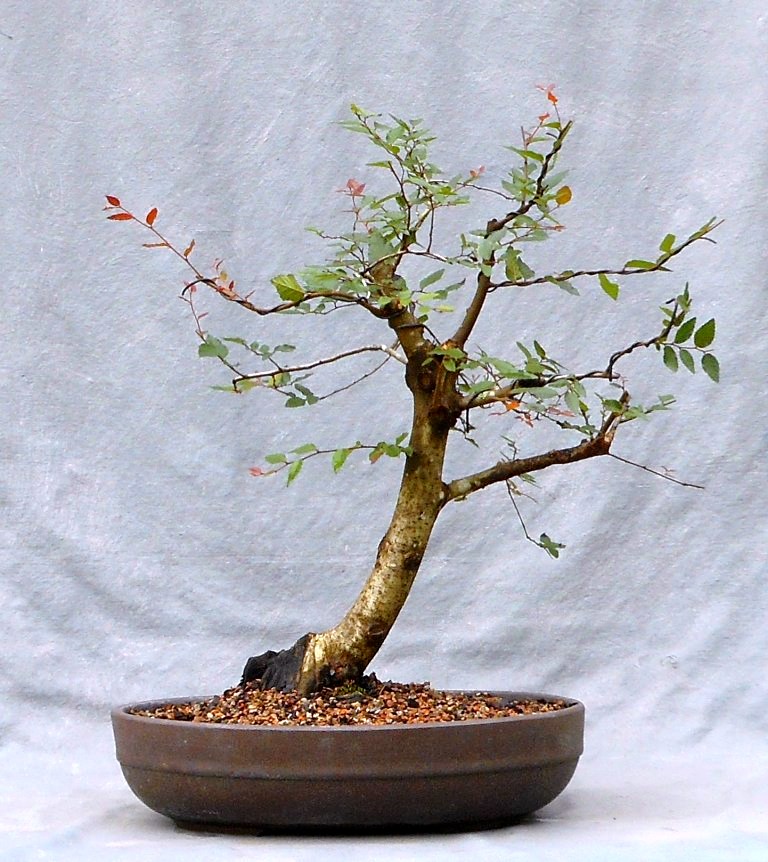
This year I decided to lift the tree in order to see if I had anything worth working on. Here’s my initial effort.

As you can see, the tree has a nice broom-form structure that happened without any intervention on my part. That’s just the way it grew.

If you look more closely at the base, you can see that the regrowth occurred over/around deadwood that actually existed (at least partially) when I first collected the tree. This photo shows the shari at the base of the tree, which was a really neat feature. This wood is pretty solid, considering that it’s been in contact with the soil for many years.

Water-elm7-15-17-3.jpg
Water-elm8-12-17-1.jpg


Today I decided it was time to work on this specimen. I also needed to move it to a different pot, because the one I started it off in was too large and (to be honest) too expensive.

I did a lot of “editing” of the branch structure, removing superfluous branches that didn’t add anything to the design. I also did a little wiring and positioning of branches to fill out the tree. Once it gets some ramification going, I think it’ll be a pretty decent specimen, especially for a tree that nearly died.

The training pot it’s in now is in better scale with the tree. It may ultimately find its way into a handmade pot; time will tell.

For purposes of scale, the root base is 2.5″ across (including the dead wood), and the tree is 17″ tall.

Let me know what you think of this tree. It’s had quite a history in just a few short years.

I Continue To Be Amazed – Here’s The Latest

Bonsai stories don’t usually develop all that quickly, bonsai being largely a matter of time and what you do here and there along the way. But this one has been something.

Chineseelm8-3-17-1.jpg

Here’s the Chinese elm I lifted on 7/29, five days later on 8/3, showing buds already.


Chineseelm8-8-17-1.jpg

Here it is today, 10 days out of the ground (and directly placed in a bonsai pot to boot).

It looks like I’ll have shoots to work with in a few weeks, at which time I’ll go ahead and wire some branches. The trunk of this tree is so neat, I don’t see how I can go wrong with the design.

Stay tuned for updates. It looks like they’ll be coming closer together than usual.

How To Let Your Trees Tell You What To Do With Them

A bonsai is a tree, shrub or woody vine potted in a shallow container and trained so that it looks like a mature tree in nature. Getting from tree, shrub or woody vine to that ideal composition, however, requires a significant array of decisions and manipulations. We start with the plant specimen. We envision a design by considering trunk, branches and root base. We trim, wire and position trunk and branches so that our design takes shape. And finally we select a proper container for the bonsai-to-be and complete our composition by placing the tree in the container.

This is a gross over-simplification, of course. But I hope in this post to give you some guidance that will make this whole mysterious process a little easier.

Cedarelm7-24-17-3.jpg


Let’s start with our Cedar elm friend from the other day.

When I decided to do the initial styling of this tree, I had to make some decisions that would ultimately produce the best outcome for it. In doing so, my first order of business was to figure out what I had and the different options available.

I can tell you that every piece of material you work on is going to present you with multiple options – even if some of those options are downright terrible.

Let me give you an example with this specimen.

On first glance you can’t help but see a normal upright tree form. This is what you’re supposed to see, by the way, because that’s pretty much what this tree is. Nothing especially fancy about it. But someone might suggest to you that the tree needed to be chopped to the lowest shoot and regrown over time. This is actually something that could be done.

But frankly I’m unconvinced that this will be a better bonsai in five or six years, when a new trunk has been regrown and perhaps a branch set is in place.

Sometimes the simple answer is the answer.

When I look at a tree like this, it just says upright bonsai and it’s got nice bark and taper and some branches I can work with.


At the end of the opening act for this bonsai-to-be, I had a workable set of branches, a front, and a planting angle. That’s what I “heard,” so that’s what I did.

Fast-forward two weeks.

I just got in some rectangular pots I special-ordered from Byron Myrick. This tree is best-suited to a rectangle; it has a masculine appearance, and a rectangle would enhance that appearance. So it was time to push the envelope again.

Cedarelm7-24-17-5.jpg
Cedarelm8-4-17-1.jpg


The tree had produced a lot of roots, so I slip-potted it with minimal disturbance to the roots.

Now, when I pulled the tree from the pot, I discovered a nice flaring root on one side. In order to take advantage of it, I potted the tree at an angle.

‘Cause the tree said so.

I think the composition is a good one. The rectangle suits the tree well, and its color should complement the Cedar elm fall colors (yellows and bronze-yellows) very nicely.


Here’s another example of listening to your tree, a Water-elm I lifted from my growing bed today. It has a nice, slender trunk with subtle movement. It’s a feminine specimen, no doubt about it. There’s one low branch, and I chopped off the trunk that extended a few feet above what you see now as the apex. It’s a tall tree, about 20″, with a trunk base of 1.25″. These are not your normal bonsai proportions, of course, but as I studied this tree I just couldn’t bring myself to chop the trunk down where that low branch is. That’s the standard way to approach trees like this one.

It’s been done millions of times. So why should I do that yet again?

This tree seemed to want to be different, and it just so happened that I had a really different pot for it. Chuck Iker made it, and it’s been sitting on my shelf for some time now, waiting for the right tree. Well, today the match happened. The low profile of the pot is just what this tree needs. The tree is feminine, so the round pot complements it perfectly. The pot actually looks like it’s relaxed, doesn’t it?

The tree should push new buds in two weeks, assuming all goes well. I don’t plan to create a full foliage mass. I think this one should be airy and light, and unless it says something else along the way that’s what I plan to do.

Water-elm8-5-17-1.jpg

So what’s the message here? Well, most of the time when you choose a tree to work on you’ll get an impression of what the tree wants to be, just from the way it’s chosen to grow. Or, as in the case of the Water-elm above, you’ll see a trunk line that looks right even though it may not fit the “normal” design ideas we usually gravitate toward. Try going with what the tree is telling you. It may take some practice, but I think you’ll find some really cool designs for your bonsai that way.

I’m Happy With This Chinese Elm, But Really Perplexed

As you know, I love to push the envelope in bonsai. I’ve always been a curious sort, and I ended up being a scientist for the first part of my work career, so my doing bon-science now should hardly come as a surprise. I like to try stuff, what can I say?

Part of the “canon” of bonsai is that you only collect certain trees at certain times of the year. Well, I’ve already done in part of the canon because I collect my Sweetgums in May and June, and don’t hesitate to collect American elms from winter through summer. I’ve had success collecting oaks in summer, along with Cedar elms. So you really don’t know until you try.

This post is about Chinese elm, Ulmus parvifolia, so let’s get to the point. First of all, Chinese elm is one of the very best species for bonsai – with the qualifier that you shouldn’t buy an “S-curve” Chinese elm, which is a crime against nature, so get one from me if you can. Anyway, I field-grow them to size. Last Saturday I decided to lift one I’ve had in the ground for three or four years, because it had the requisite number of direction and taper changes, in this case four. I literally built this tree from the ground up. Here it is, after lifting, washing, dusting the cut ends of the lateral roots, and pottin

Chineseelm7-29-17-1.jpg

It’s pretty awesome. No S-curve here. From the terrific nebari up into the trunk, the taper, the movement, it’s got a super start. As with all deciduous trees I work with, it’s at “ground zero.” That means I start with a bare or mostly bare trunk, and wait for buds to emerge at the right spots. Usually with Chinese elm, I get them where I want them.

At this point I set my “clock” for two weeks in the future. The tree was lifted on 7/29, so that meant I should see new buds on 8/12. I placed it on the bench in a shady spot, and went about my business.

Chineseelm8-3-17-1.jpg

Here’s a shot of the tree today. You may wonder why I took the trouble to photograph it again.

Well, here’s why (take a look at the next picture) …


Chineseelm8-3-17-3.jpg

In five days the tree is full of swelling buds!

To be sure, I always expect good performance from Chinese elms. But I don’t expect a specimen I lifted from the ground less than a week ago to be pushing buds!


I guess this will fit nicely into my bon-science lessons learned. I admit to having some trouble with Chinese elm specimens collected in the dead of winter. It’s always puzzled me why that was, but I adjusted and now only lift Chinese elms once the buds are starting to swell in spring. But now, woo hoo! I can lift them in summer too.

The next step with this tree is to just neglect it except for watering. I should have shoots to make branches out of in about three or four weeks. I’ll wire up a design, then ignore the tree some more into winter. Next spring it should be ready to start taking on some character. The nice thing about this specimen is it has all the taper it needs already, so by the end of the next growing season I should have a complete tree structure. Nice!

Let me know what you think. Leave a comment below.

Don’t Feel Bad When You Get The Front Wrong

Oaks make great bonsai. They grow quickly, meaning you can get fast development. And they’re fairly easy to collect.

Wateroak4-9-17-1.jpg

This Water oak, Quercus nigra, is a good example. I collected it this past January. The trunk has good character and taper, and it proceeded to pop buds in some really good spots. Making a believable bonsai out of it was going to be a breeze.

Wateroak7-4-17-1.jpg

I potted it on July 4th into this nice Byron Myrick oval. There was no doubt in my mind that the tree would work best as a slanting style specimen, so that’s what I made happen. I thought it looked okay when the work was done, but I also thought it could be better.

This brings up a very important point when you’re designing and developing your bonsai. Where’s the front? Virtually all bonsai have a very distinct front, one viewing angle that looks better than all the other possibilities. But with this understood, finding that perfect front is not always easy. And sometimes you’re going to get it wrong. I know I do.

Yesterday I was doing a little trimming on this tree, and decided to turn it to see if maybe I missed the front when I was first potting it up. This is what I came up with.

Wateroak7-28-17-2.jpg


Yep, I definitely got it wrong the first time.

This front is so much better I’m a little disappointed I wasn’t able to spot it before. But that’s okay. I have had trees on my bench for years, training away on them, and only some time later discovered a better front. So it does happen, and the good new is you just turn the tree and continue the work from there.

You can’t see it in this photo, but two more things needs to happen with this specimen.

With the front now spotted successfully, the tree needs to be turned slightly in the pot, moved slightly to the rear and repositioned so that it leans toward the viewer. All of this can be done next spring.

This tree is available at our Oak Bonsai page. Turned the right way, too!

How To Make Great Designs A Little At A Time

Cypress7-22-17-1.jpg

I’ve shown you this Bald cypress forest, Taxodium distichum, in previous posts. It was bequeathed to me by Allen Gautreau, and old bonsai friend I’d known for 25 years. Allen did a really good job of designing this forest, including a nice selection of trees based on trunk size and height, and the composition is pleasing. It has the look of a forest. Over time, the trees took on an aged appearance, which is just what you want to happen. And Allen had paid attention to detail on the individual trees, ensuring they exhibited a natural growth habit.

This forest has needed repotting since I got it, but I’ve put off the chore for no particularly good reason.

A couple of weeks ago I defoliated it, in preparation for the work (which I should have done at the time, but just didn’t get to). The roots were really grown together, of course. This is something to bear in mind whenever you repot a forest. Do you separate the trees or repot the mass of trees as a group? Well, it depends a lot on what needs to be done in regard to the composition. If the composition is as you want it, then repotting can consist of pruning the roots around the edges of the forest in the pattern of the trees’ footprint. This provides growing room for new roots, which is the purpose of repotting in the first place.

On the other hand, if you have to change your composition you’ll be faced with the chore of separating the trees. This is done by cutting apart the root masses. If you’re able to lift the forest out of the pot to get at the roots better, then by all means do so. If not, then you’ll have to cut into the root mass in the pot to achieve the separation.


The only real problem I saw in this forest was the arrangement of the smaller three-tree group. I felt the two trees on the right of this group should be closer together, which would enhance the visual depth of the group and thereby the composition itself. It was a small change, but I thought making it would improve the composition a great deal. So with that in mind, I set out to cut apart the forest.


But first, the trees all needed a good trimming to restore their silhouettes. I shortened most of the branches and removed some unnecessary ones.

Once that was done, I started with the main tree and used my root-pruning shears to get down into the root mass.

My plan was to move this forest to a vintage Richard Robertson tray, which I felt would give it a more “swampy” appearance.

I started with the main tree because it’s the basis of every forest composition – the linchpin, as it were. Where you put this tree determines where the others need to go. I didn’t plan to reposition the main tree, but nonetheless it needed to be planted first.

The others then took their places, with the edits that were needed on the smaller group.

Cypress7-22-17-2.jpg
Cypress7-22-17-3.jpg


Here’s the end-result of the work.

Notice what I did with the three-tree group. I actually repositioned the far-right tree behind and to the left of the middle tree – with a slightly narrower trunk, it can now provide much more visual depth to the group along with the overall composition.

I probably removed about half of the root mass of each of the trees in this repotting. I don’t expect this to slow down the recovery much at all. With the new buds pushing now, I should have a new flush of foliage in about three weeks.

Let me know what you think of this forest in its new home.